

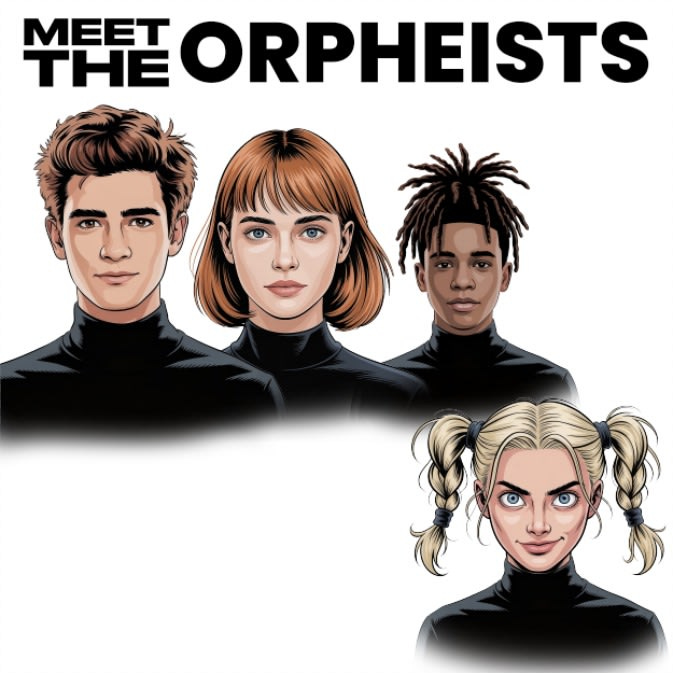
“We do know another important thing about the past,” she said. “Around the same time the Orpheus Guild was started, a rival musical association began. The Hephaestus Society. They’ve been the opponents since, in every battle.”
“What’s Ha-fes-tis mean?” Juli asked.
“Hephaestus was a Greek god, the god of builders,” Mom said. “Carpenters, craftsmen, stone workers, blacksmiths, metallurgy, fire. He made weapons of war, jewelry for the rich, the magnificent cities. Everything artificial, everything created by the hand of humans. Statues that looked like people but were lifeless. Orpheus, they said, was able to charm everything in the natural world with his music, sooth lions, hypnotize snakes, tree branches would reach out to embrace him, even huge stones would rise up into the air and moved to where he wished them to be. In other words, he could control natural things, but not by changing them – by connecting to their vibration, their fundamental essence. That’s what ‘charm’ meant. He could become unified with nature through his music, then influence it, to the betterment, never changing the forms of nature itself.”
“But you can’t seriously say building things is all bad,” Madeline said. “Cities have libraries full of books, schools and universities where people learn. Living in homes protected from the elements, with a water supply. Able to be clean. Trade going on, so new things are introduced from other places, like tea, coffee, spices, woven cloth. Advancements in medicine. This is all a good kind of change, right? Joni Mitchell was living with Carey in a cave in Greece, but after a while, she missed her clean sheets and fancy French perfume. That’s why they call it civilization. It’s civilized, that’s good.”
“Yes, it is, darling, you’re right. Of course.” Mom said. She took a sip of lemonade. “I love my lemonade. Water, sugar, lemons. That’s it. All natural. But lemons don’t grow here in the northeast. We get winter freezes. So in order for me to sip my lemonade, there needs to be the lemon trees down south and out west, the groves and the workers, picking the lemons, the refrigerated trucks transporting them, the interstate highway system all over America, more than 48,000 miles of road. In order to create it, over a million people were driven out of their neighborhoods and homes. To make way for the highway.” She took another sip. “So today I can drive to the market and pick the best from the never-ending piles of fresh lemons there. Yes, I do love my lemonade.”
“I’m missing something here,” Juli said. “What’s lemons got to do with music?”
“If you squeeze one, the juice runs down your leg,” Kai said, grinning, then looked sheepish. “Sorry about that, Mrs. E.”
“No worries,” Mom said.
“I’ve heard that before! Where’s it from?” Juli said.
“Robert Johnson,” I told her.
“No, it was somebody else,” Juli answered.
“Led Zep,” Madeline said. “They stole it. Anyway, the point was, if I may, Julianne,” Madeline went on, with Mom’s nod, “all of this civilization we’ve got, that we like so much, comes with a price.”
“It does,” Mom smiled, a tight thin smile. “Such a high price that the natural world is losing the battle. What happens when heat waves and droughts wipe out the lemon groves and I go to the market to find no lemons there? Then things aren’t as civilized anymore.”
“That’s not about to happen anytime soon,” Kai said. “Hope not anyway. I love your lemonade, Mrs. E.”
“It might be sooner than we think,” she said. “There’s an urgency now. The battle has always been about the proper balance of these two things – what’s built by human hands and what grows from nature. People need both, but when one side starts overtaking the other, problems start.”
“Like the Europeans taking over America from the Native people,” Kai said.
“That was one the worst defeats - when the battle was lost just before Columbus. Europeans could have learned so much about conserving the land, protecting nature for generations to come.”
“Seven generations,” Kai said. “They thought about how everything they did would affect their children, seven generations ahead.”
“An incredibly wise way to look at things. Instead, the settlers thought about immediate needs, and immediate greed, and ravaged nature,” Mom said. She sipped some lemonade. “And now nature is teetering. The worsening storms are signs that the earth is trying to balance itself, regulate the temperature that we’ve caused to rise to life threatening levels. The battle is more important now than ever. And you’ll be facing a formidable opponent, The Hephaestus Society.”
“How good are they?” Madeline asked.
“Very very good. Technically proficient. More structure than beauty, as you might guess. They adore heavy metal shredders. At times, that speed and dazzle wows the crowds. That’s why you’ll have to be both – technically astounding and emotionally stirring.”
“A difficult balance,” Madeline said.
“It is,” Mom said. “Along the way, each side made up nicknames for the other. The Hephaestus society became The Automatons. The Orpheists became The Green Men. But then as women began playing on the Green Men side, it turned into just The Greens.”
“So we’re The Greens?” Juli asked, noticeably disappointed.
“We’re not The Automatons, sweetheart,” Madeline smiled.
“Well, I know, but it sounds so much cooler,” Juli shrugged.
“You’re the next Orpheists,” Mom said. “Be proud.”
“How about ‘Be victorious?’” I said.
Mom looked over at me, calmly, with a seriousness on her face I’d never seen.
“Yes,” she said. “Better still.”